


|
News Source: topspeed.com
|
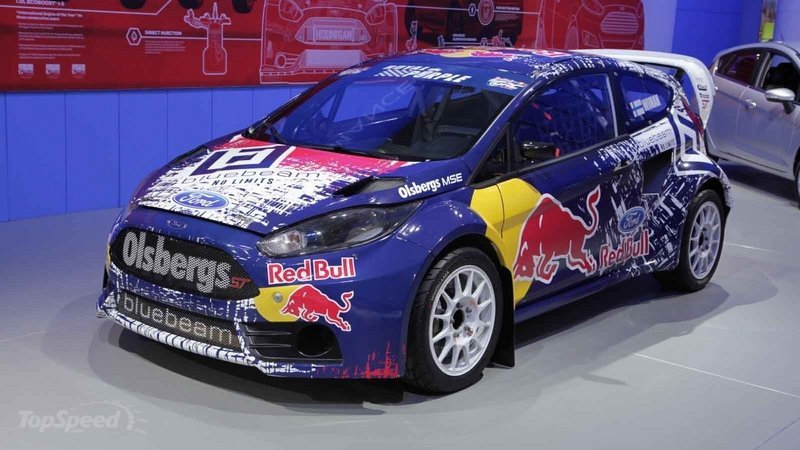
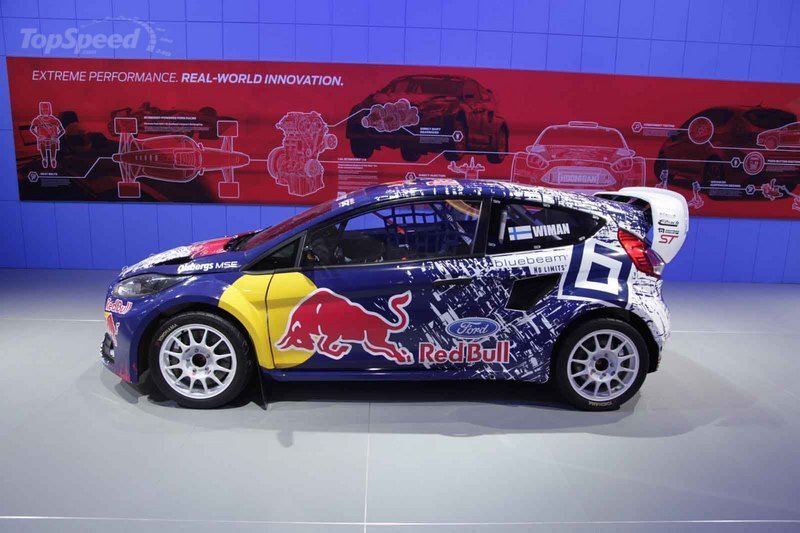
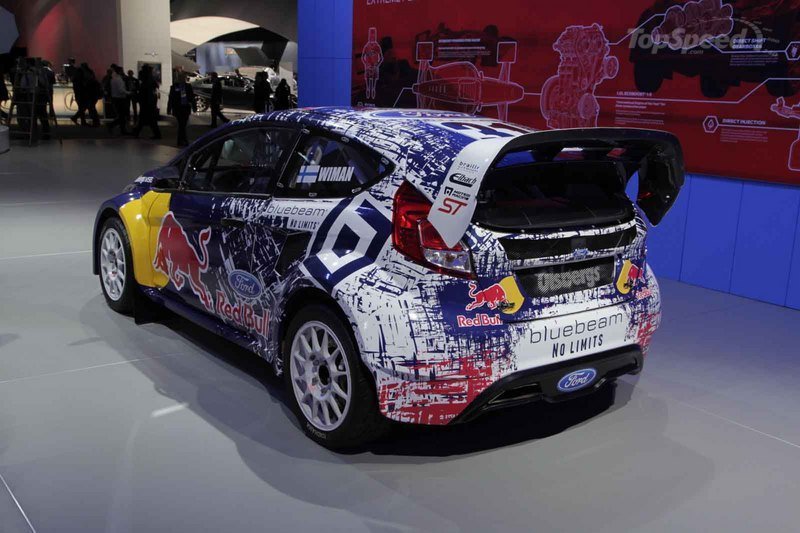
“Dominant” is one word that springs to mind when considering the Ford Fiesta’s performance in the Red Bull Global Rallycross Championship (GRC). Going into the 2014 season, the supermini was responsible for three driver’s championships and three manufacturer’s championships, each claimed consecutively since the series’ launch in 2011. In 2013, the Fiesta won nine of the 10 scheduled races and claimed 22 of the 30 available podium spots. Last year, this American-bred hatchback added to its already impressive record with yet another driver’s championship, another manufacturer’s championship, three race wins, and 18 podiums. Of the six different teams flying under a blue oval in the 2014 GRC season, Sweden’s Olsbergs MSE was undoubtedly the best. While other Fords contributed to the automaker’s overall series supremacy, it’s only Olsbergs MSE that can currently boast a four-peat championship drive, with Tanner Foust crowned winner in 2011 and 2012, followed by Toomas Heikkinen in 2013, and Joni Wiman in 2014. The Fiesta has a long history of rally competition success, with different versions of the party-maker entered in series both nationally and internationally. But somehow, it’s the Olsbergs MSE Fiesta that comes out on top every time at GRC. So, what is it that makes this Fiesta ST so successful? Part of it is the talent behind the wheel, which in 2014, included Patrik Sandell, Brian Deegan, Nelson Piquet Jr., and the new reigning champion, Joni Wiman. The other half of the equation is the team itself, which works closely with Ford to develop the Fiesta ST platform to its utmost potential. Olsbergs MSE is also responsible for a variety of GRC Supercar Lites, which extends its competition knowledge even further. Like any good racing team, Olsbergs MSE is always in development, constantly building on past successes, solidifying its lead around a competitive field hungry for victory. Simply put, it’s a philosophy that translates into trophies. The Olsbergs MSE rallycross champion sports an updated body that imitates the bodylines found on the Mk. VII three-door Fiesta ST. However, the body panels are made from super-strong and super-lightweight composites to resist the copious amount of fender rubbing seen in each GRC match. The rest of the car is built equally tough and feathery. For example, the Swedish team worked closely with Motegi Racing to create custom wheels, which are “designed to sit flush with the car, decreasing the risk of broken wheels from contact.” They also decrease rotational mass and can withstand the rigors of repeated 70-foot jumps. Total weight for the Ford comes to a minimum of 2,866 pounds, which includes the driver. The office for the Olsbergs MSE Fiesta is as you would expect, with bucket seats, racing harnesses, and a chrome-molly roll cage to protect the occupant should he find himself suddenly running out of talent. An AIM digital information readout sits in a carbon-fiber dash directly behind the removable steering wheel, feeding through all vital numbers and figures. Rising above a large layout of switches and buttons in the center console, you’ll find a hydraulic handbrake and sequential gearshift lever to round out all necessary driver inputs. Oh yeah, there are some pedals too. But that’s pretty much it. The screaming heart of this race car is a 16-valve, turbocharged, 2.0-liter, Duratec-HE four-cylinder with an Olsbergs MD head. The team is partnered with Mountune to help calibrate engine parameters for absolute reliability and as much performance as possible. Performance parts include a Pectel ECU, Tibuc inlet manifold, PWR intercooler, Magnaflow exhaust, and a titanic Garrett boost-maker. These reportedly add up to 560 brake horsepower at 6,400 rpm (although peak power is probably closer to 600), and 620 pound-feet of torque at 4,000 rpm. 0-to-60 is achieved in around two seconds Putting that power to the ground is eased with a permanent four-wheel-drive system, complimented by no less than three limited-slip differentials. Either a Sadev six-speed sequential tranny, or five-speed Maktrack tranny is used, depending on gearing needs, while an Alcon three-plate carbon clutch keeps it all connected. The 2014 GRC season saw the implementation of a new radial tire from Yokohama, which is a surprisingly big change for a race car. New tires can have a cascading effect on general suspension set-ups, but luckily, Olsbergs MSE was able to keep the overall geometry unchanged. The team instead focused on maximizing traction for the dual-surfaces upon which the new compound would run. Finding the right balance between dirt and tarmac grip, while compensating for large jumps and variable track configurations, is not an easy task, but the Olsbergs MSE Fiesta seems to handle it without much fuss. |

|

| Copyright © 2026 • www.showcar.com.au • Showcar Pty. Ltd. • Contact info@showcar.com.au | sydney web design & development by Webski |