11:46PM - 31.01.'15
|
News Source: autoblog.com
|
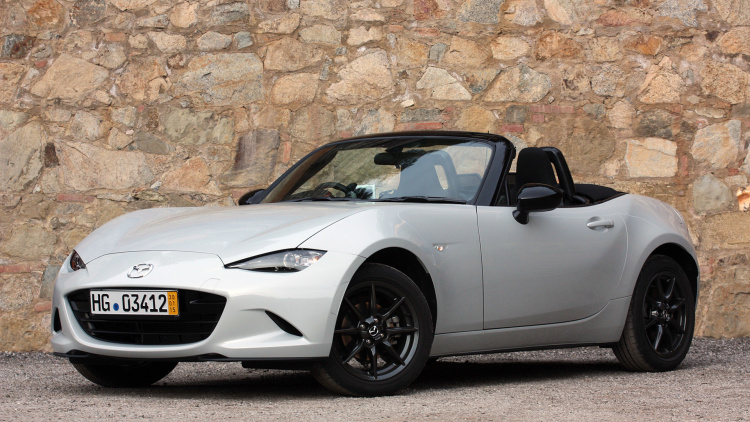
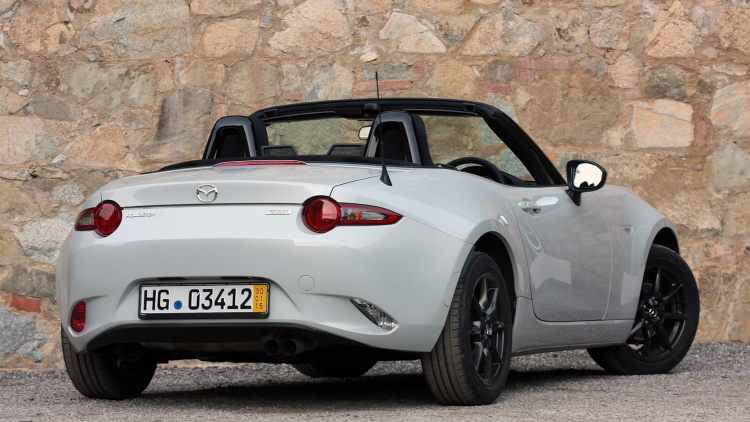
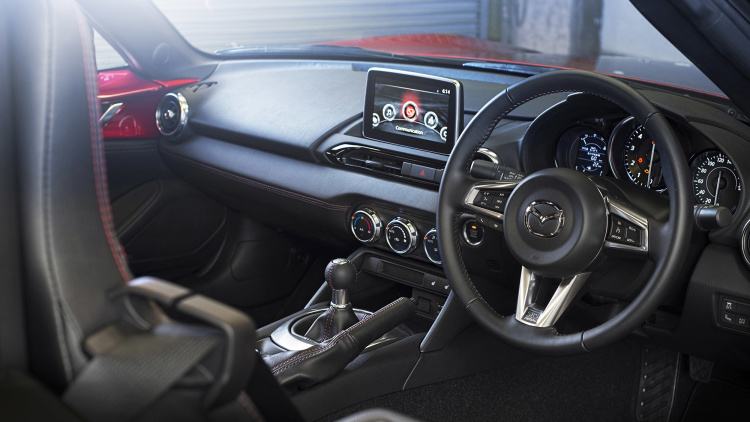
Hypothetically speaking, if you blindfolded me, put me in the car pictured above, and told me to hit the road, it would have taken me maybe two minutes to figure out that I was driving the 2016 Mazda MX-5 Miata. There are just certain facets about Miata driving that have been baked into every generation of Mazda's roadster, and it makes for a symbiotic relationship between car and driver that's truly unique. Sure, I could rattle off a list of cars that come close to offering the same sort of experience, but they just can't quite capture the same intrinsic Miata magic. Mazda knows its Miata is an incredibly special machine. Listening to the company's engineers and designers talk about the development of this fourth-generation ND model is fascinating. The attention to detail is astonishing, and every single person involved in the Miata program knows that the most important goal is to keep this car as true to its predecessors' ethos as possible. It cannot just be a great convertible, or even a great Mazda – it has to be a great MX-5 Miata. But the company did not just want to improve upon the third-generation NC Miata, which has been around since 2006. They wanted to tie the ND Miata's roots back to the original NA from 1989. Back in '89, the Miata was a less-powerful, 1.6-liter model with 115 horsepower and 100 pound-feet of torque. Mazda's team said they are proud of every version of the MX-5, but it's this specific, first-generation model that the company calls the "most right" – the most true to the idea of what a Miata ought to be. So that's why, before being allowed to attack the winding roads of the Spanish countryside in the 2016 MX-5, Mazda wanted me to spend some time with a cherry example of the original NA Miata: a Mariner Blue darling that, even with some 239,000 kilometers on its clock, still felt absolutely impeccable from behind the wheel. Light, responsive, and perfectly balanced, it was the original embodiment of the harmony between driver and car that Mazda wanted in every Miata. Mazda executives said they felt the first Miata was also the right size. So they chopped off three inches on the ND compared with the NC, and put it on a wheelbase that's been reduced by six-tenths of an inch. In fact, these dimensions mean the new Miata is more than two inches shorter in length than the original, and only two-tenths of an inch taller. In this day and age of ever-expanding waistlines and footprints, it's a remarkable achievement. There's also been a significant weight reduction, and while Mazda has yet to publish final specifications for the ND car, the company is touting a savings of 220 pounds compared to the NC. In other words, expect a curb weight somewhere around 2,200 pounds for a Japanese-spec model – only 100 to 200 pounds heavier than the original despite additional equipment. Mazda achieved this lower mass thanks to – you guessed it – aluminum components, as well as increased use of high-strength steel. And because it's all about the details, the Miata team added aluminum in areas furthest away from the car's center of gravity, to keep the bulk of the mass as close to the ground, and middle of the chassis, as possible. That's also the reason for moving the engine 13 millimeters lower, and 15 millimeters backward on the chassis. It now sits fully behind the front axle, technically making the Miata a front mid-engined car. I could dive into a discussion of styling, but you've no doubt already pored over dozens of high-resolution images, and our NB-owning executive editor has since registered plenty of apt observations about the new car. Just know this: the styling was done for form, not function. Don't like the headlamps? Too bad. Mazda wanted to get that hood as low as possible, and then worried about fitting in the projector-beam LEDs. It's a much more aggressive car, and on the road, it looks great. The cloth top structure now uses aluminum components, and before you ask, Mazda would not say one way or the other if a Power Retractable Hard Top will be offered. That said, if earlier reports are to be believed, consider the PRHT out of the cards. The cloth roof is just as simple to operate as before – unlatch it and throw it behind you. This is another important part of the Miata formula: it was key that the driver not be constricted in the cockpit, and could easily turn to reach behind for quick top-up/top-down switches. I'll get back to the interior stuff in a moment – for now, have a look at the soft top's simplicity in the video below. Of course, unless it's raining cats and dogs, you shouldn't be driving a Miata with the top up anyway. Top-down driving is so important to Mazda that the door trim and A pillar were designed to specifically direct air over the top of the car, but have it channeled in through the sides, so the driver feels a "pleasant breeze," according to one engineer. To further enhance topless driving, Mazda has one again added audio speakers into the headrests, so you won't need to crank the stereo. For my drive through the countryside outside of Barcelona, the music I preferred came from the Miata itself. I focused on the muffled, yet present exhaust note of the 2016 MX-5, coupled with an engine sound that's less harsh and buzzy than before. There's still very obviously a four-cylinder working under that hood, but it's more refined than in previous generations. When it arrives in the US later this year, the Miata will be offered with a 2.0-liter Skyactiv-G inline-four, producing 155 hp and 148 lb-ft of torque. Believe me, you won't miss those ponies. Yes, I realize that's a decrease of 12 hp, but hear me out: you get 8 more pound-feet, and the car weighs over 200 pounds less. |