


|
News Source: topspeed.com
|
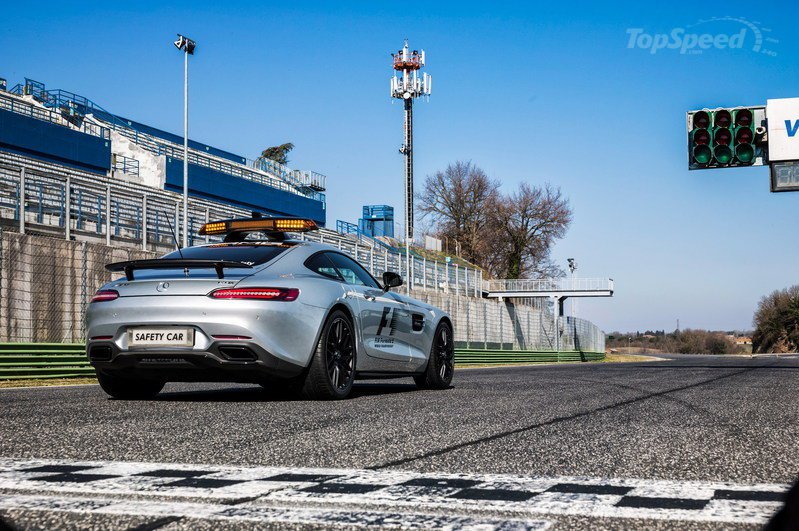
As the first sports car developed independently by Mercedes- AMG, the SLS AMG did its job faithfully as a Formula One safety car, starting with the 2010 season and ending its run five years later. With Mercedes-Benz deciding to retire its modern Gull-wing last year, the 2015 Formula One season was in dire need of a new safety car, and since the Stuttgart carmaker has an exclusive contract with the FIA, it delivered. Approximately one week before the 2015 Formula One World Championship starts, the German carmaker quietly unveiled its new safety car at the Vallelunga Circuit, a mildly modified but otherwise production version of the Mercedes-AMG GT S. Still driven by legendary Bernd Mayländer, who has handled F1 safety car duties since 2000, the new car will make its first race appearance at the Melbourne Grand Prix, between 13-15 March. The aerodynamic light bar on the roof is positioned on a carbon-fiber air scoop, which optimizes air flow to the rear wing. At first glance, the Mercedes-AMG GT- S looks like a series production model with a light bar on its roof, but it does in fact differ in a couple of more areas as well. Apart from the eye-catching FIA and F1 logos, the model also features elements included in the GT Aerodynamics package, part of the Mercedes-AMG GT "Edition 1" package. A more pronounced splitter is fitted to the front end, while sportier side skirts and a small, fixed, rear wing improve both the model’s looks and its downforce. The aerodynamic light bar on the roof is positioned on a carbon-fiber air scoop, which optimizes air flow to the rear wing. The entire package has been developed in the wind tunnel, so it should be pretty efficient. The LED light bar performs two functions: when the safety car is deployed, the orange LEDs are switched on, with the flashing orange light in the middle and steady lights on the outer ends translating into "absolutely no overtaking." On the other hand, if the car ends up in the middle of the field at the beginning of a safety car period, the two central LED panels on the front and rear of the light bar are green, thus signaling to the F1 drivers that the Safety Car may be passed. The rear license plate on the car is also fitted with orange and green LED lights, synchronized with the roof light bar. During low visibility, a stroboscopic effect from the headlamps and taillights can make the safety car more noticeable. Two cameras, one mounted on the light bar and the other on a tray between the seats, provide live coverage of what is happening around the GT S safety car at all times. Bernd Mayländer isn’t doing his job as a safety car driver alone, as he is accompanied by FIA Fuel Analysts Peter Tibbets, who is in radio contact with race organizers and Mayländer at all times. Apart from transmitting orders, Tibbets also has access to two iPads integrated into the car’s dashboard. The extendable iPad on the center console can show the international feed of the race, while the larger, right-hand one can show an animated presentation of the position of each vehicle on the track, and current lap times. The safety car is equipped with an InCar Hotspot with WLAN, a transponder system for timing purposes, high-resolution GPS and the same telemetry system used on every Formula One race car. Both occupants benefit from sports bucket seats with six-point seat belts, and there is an on-board "Marshalling System, which uses LEDs for signaling the various flag types for every section of the track ,and also flash intermittently if there’s an accident in which the G-force limit has been exceeded. Those numbers translate into a naught to 62 mph acceleration of just 3.8 seconds and an electronically limited top speed of 193 mph. Just like a road-going Mercedes-AMG GT S, the new F1 safety car is equipped with a twin-turbocharged, 4.0-liter, V-8 engine that delivers 510 horsepower and 479 pound-feet of torque. Those numbers translate into a naught to 62 mph acceleration of just 3.8 seconds and an electronically limited top speed of 193 mph. The power is transmitted to the rear wheels via a seven-speed, dual-clutch transmission that is also identical with the one from the production model. The safety car is fitted with dynamic engine and transmission mounts, firmer spring and damper tuning, more negative camber for the front wheels, a speed-sensitive sports steering system and a carbon-ceramic brake system, all of which are optionally available for the production GT S. To aurally satisfy fans of the naturally aspirated, 6.2-liter V-8 in the SLS AMG SC, the Mercedes-AMG GT S Safety Car is equipped with a modified performance exhaust system that is likely not road-legal. |

|

| Copyright © 2026 • www.showcar.com.au • Showcar Pty. Ltd. • Contact info@showcar.com.au | sydney web design & development by Webski |