10:54PM - 13.03.'15
|
News Source: autoblog.com
|
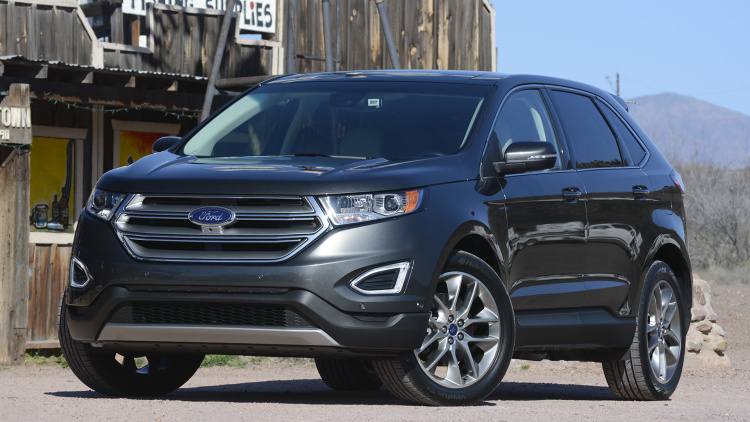
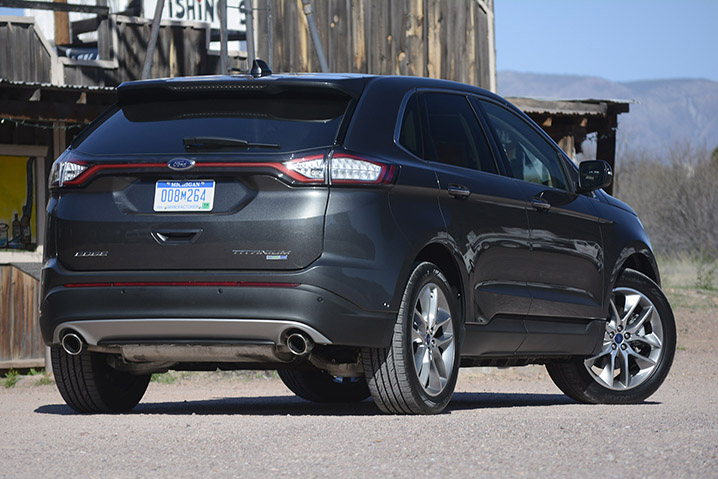
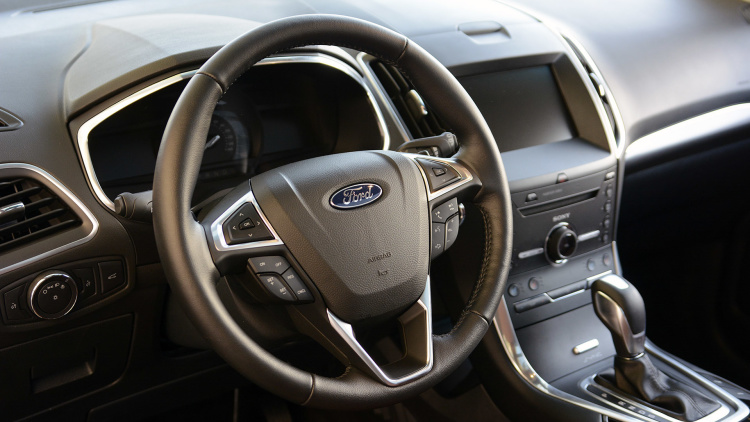
We're routinely told that it's not easy being the middle child. The oldest sibling will always outshine the rest, while the youngest is routinely doted upon. The middle child, meanwhile, is seemingly never able to measure up. You know the drill: Marcia, Marcia, Marcia! But that hasn't really been the case for Ford's mid-kid crossover, the Edge. Sandwiched between its highly successful big brother, the Explorer, and the stylish younger brother, the Escape, the Edge has had plenty of its own bragging rights over the years. It's where the Blue Oval chose to first launch MyFord Touch in 2011, and was one of the company's first applications of an EcoBoost engine in a CUV. For 2015, Ford has given the Edge a brand-new outfit, complete with stand-out sheetmetal and a revamped 2.0-liter four-cylinder engine fitted with a twin-scroll turbocharger and direct-injection. The result is a vehicle that truly stands out from its compact and fullsize siblings while promising to retain Ford's edge in the midsize CUV market. Where many of Ford's cars have opted for a slim, Aston Martin-like grille, the new Edge's face is big and bold. It's around back, however, where the Edge really comes up with its own personality. The slimmer D-pillar forms the edges of a more aggressively raked rear window. It's difficult to spot in pictures, but the result is a decidedly more assertive profile than the outgoing CUV. Beyond that, the rear is home to Fusion-inspired taillights, although unlike Ford's popular midsize sedan, they're joined together by a vehicle-spanning lighting element that prominently features a Ford badge at its center. Ford's work on the Edge's interior is less progressive, though. The owner of a 2014 model wouldn't feel the least bit out of place climbing behind the wheel of a 2015, as it features Ford's same reconfigurable instrument cluster, and a center stack that's been crowned by the latest (and final) edition of MyFord Touch. Meanwhile, more IIHS Initial Quality Survey-friendly buttons have replaced the obstinate and unintuitive touch-capacitive controls. The conservative take on the interior design belies the big improvements in material quality. The leather inserts in the doors are more heavily padded and the plastics are far softer. It's a similar story throughout the cabin, where owners will notice softer dash plastics and generally richer materials. That said, Ford (and Lincoln) are developing a disturbing habit of finishing the center stacks of their vehicles in a hard, character-less black plastic. Shown above in the gallery around the HVAC controls, it disrupts what is otherwise a cleanly styled cabin and makes it seem like a total "oops, we forgot this part" afterthought. Meanwhile, areas integral to the driving experienced are well addressed. The seats are wide and comfortable on our Titanium-trimmed tester, and they're finished in soft, perforated leather. Support is limited, but these are thrones designed more for the long haul than the lap record. The steering column tilts and telescopes, and there's a large, leather-wrapped wheel. While the diameter is relatively big, it's not a handful – those that are small of hand (roughly 50 percent of the Edges Ford sells are to women, after all) need not be concerned. One of the more prominent new additions to the Edge is Ford's new Enhanced Active Park Assist system. Though not a totally new idea, it comes with enhanced capabilities in the 2015 Edge. It can now pull out of parallel parking spots, while also backing the vehicle into perpendicular spots. While Ford will outfit your Edge with the carryover 3.5-liter V6, we're much more concerned with the standard engine – a new 2.0-liter turbo four that's different than the unit found in the Fusion and Escape. Not only is the Edge the first vehicle in the Ford family to offer EcoBoost power as standard, it is the first vehicle in the brand's US lineup to get the new 2.0T. While it might not look that different from the current 2.0-liter EcoBoost on paper – it produces 245 horsepower and 275 pound-feet of torque, gains of 5 hp and 5 lb-ft over the outgoing engine – the big story is that consumers can now pair the 2.0T with an all-wheel-drive system that's capable of transferring up to 100 percent of the engine's output to its rear axle as needed. That said, the Edge's 2.0T is not a performer, despite producing more than 120 hp per liter. According to our wristwatch, it takes around ten seconds to hit 60 miles per hour, likely thanks to the crossover's 4,060-pound curb weight. The soft throttle response doesn't help with the lack of off-the-line speed, either. Slow sprint aside, there's plenty of usable power when you're already on the go. With peak torque at 3,000 rpm, you're rarely far from max twist. Moreover, Ford continues to maintain a firm grasp on turbo lag. That means, especially at speed, it doesn't require a lot of planning to make a pass. The bottom line here? The vast majority of Edge owners should find the 2.0-liter an adequate companion for everyday driving. Those who don't can pay $425 to upgrade to a naturally aspirated, 3.5-liter V6, or they can move up to the Edge Sport with its fancy new twin-turbo, 2.7-liter V6. |