06:35AM - 01.06.'13
|
News Source: motortrend.com
|
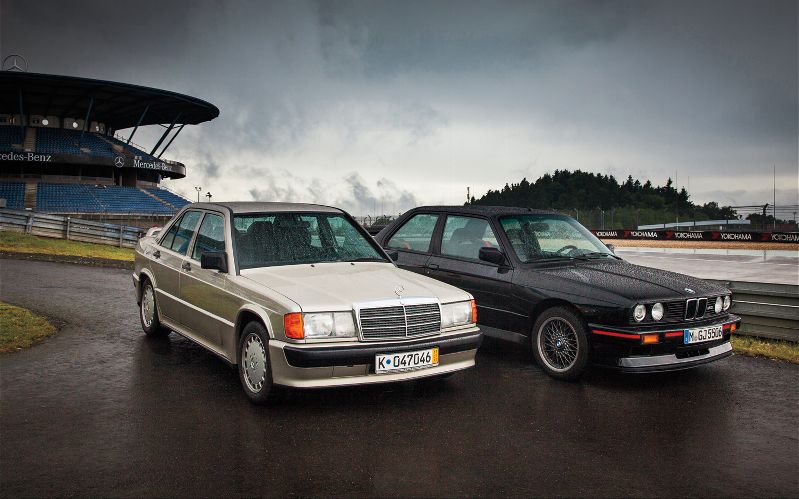
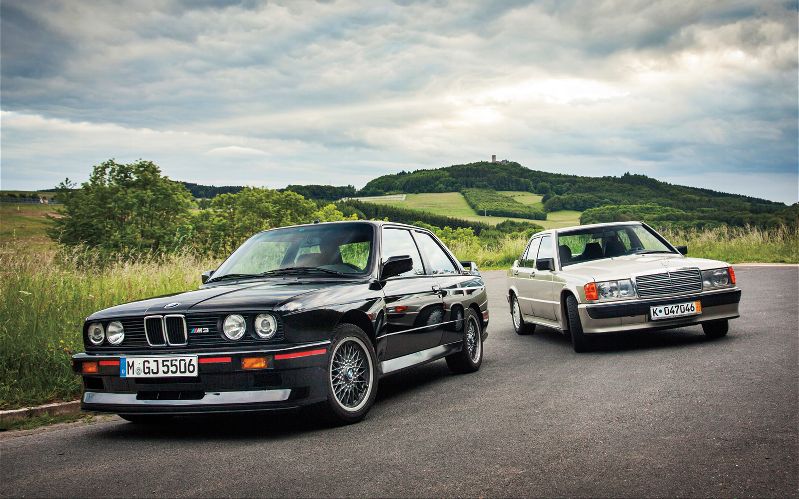
Dense morning air caresses their exquisitely crafted bodies with passing clouds of condensation, a temporary fog on paintwork as reflective as an undisturbed pond. Rear spoilers stand proudly above angular trunklids, poised and ready to deflect the fiercest of autobahn winds. Glistening in the sunlight are the three-pointed star and the roundel, badges belonging to two of the most respected names in the automotive business. Finally, someone starts their engines and they sound like a pair of clapped-out Yugos on a used-car lot. The cacophony is the sound of forged pistons and solid valve lifters. These are not normal cars. This is important stuff.
The W201 190E 2.3-16The Mercedes-Benz W201-chassis four-door sedan, commonly known as the 190E, was a very big deal because of its very tiny size. Yes, "tiny." Were the 190E on sale today, it would be the smallest four-door sedan you could buy in America. In the late 1970s, the idea of a subcompact German luxury car was unheard of, but American CAFE standards were looming. As a stopgap, Mercedes stuffed diesel engines into its fleet of large cars, but the company knew it needed smaller, more fuel-efficient cars to meet our requirements. Thus, the "Baby Benz" was conceived. The 190E had to be indistinguishable from any other Mercedes from its driver's seat -- that's right, the car the size of a pea would have to feel like the princess' full-size coach. To achieve that stunt, the precious W201 would be overengineered to the point of ridiculousness. (Its development is rumored to have cost nearly $4 billion in today's dollars.) And while we're on the subject of ridiculous, to make sure the world took the little Merc seriously, the W201 would be designed not just to enter the World Rally Championship, but to win. Cosworth was retained to design the 16-valve cylinder head, and Walter Röhrl was signed to do the driving. Mercedes developed and patented an exotic five-link rear suspension that was to provide the best wheel control of any road-car suspension ever produced. And just when it all started looking promising, Audi ruined the day by inventing an all-wheel-drive system called Quattro. It was suddenly game over for two-wheel-drive cars in rallying, and Mercedes' management board was so aggravated that it instituted a company-wide ban on all motorsport participation. Mercedes engineers didn't listen. They quietly continued development of a racing 190E -- this time for the new German touring car racing series, DTM. They would distract the board by disguising the race car as a factory-tuned W201 for the street, and to prove its mettle, Mercedes took it to the Nardo test facility in August 1983. It shattered three world and nine international speed records, averaging 154.06 mph over 50,000 km (31,069 miles). The production version, called 190E 2.3-16, made its debut the following month at the Frankfurt auto show. By the time it hit public roads in 1984, its first year of production was sold out -- a fitting debut for a subcompact sedan that could outperform the legendary 300SL Gullwing. It cost thousands more than a base S-Class, but the 16-valve 190E could handily outrun the topline, V-8-powered 500SEL on the autobahn, despite having less than half the displacement. The Cosworth-headed screamer extracted a manic 182 hp from the short-stroke, 7100-rpm four, and an aggressive body kit cut the regular 190E's aerodynamic lift by almost half. The 16V had a manual gearbox with a racing-style dogleg first gear and Recaro bucket seats front and rear. Numerous handling and braking modifications included self-leveling air shocks in back, and the results were the highest cornering grip ever seen in a Mercedes and braking distances among the shortest ever measured by contemporary car magazines. By the end of 1985, 5000 Cozzie-Benzes had been built, enough to satisfy FIA Group A homologation rules. With the motorsport ban still in place, however, Mercedes couldn't officially take the baby Benz racing. Instead, its engineers provided under-the-table assistance to independent DTM teams (including AMG), hoping the management board wasn't paying too close attention. Oh, but every engineer in Munich was watching. Of all the big horsepower, world-dominating grenades Mercedes had thrown over its fence (the 300SEL 6.3 and the 450SEL 6.9, to name two), the 190E 2.3-16 was the one that landed in BMW's backyard. And BMW's response was absolutely breathtaking.The E30 M3In contrast to the W201 Mercedes, the E30-chassis BMW 3 Series was, in and of itself, nothing special. When it arrived in 1982, BMW had been gradually perfecting the compact sport-sedan recipe for decades, and the E30 was "just" another descendant of the 2002. It wasn't until years later, when the 325i introduced a glorious new 2.5-liter straight-six, that we seemed to realize the E30 was, in fact, the second coming of the sport sedan. A scant year later, the 325i was completely overshadowed by Bavaria's answer to that 16-valve Mercedes -- a shotgun blast to the face called the M3. M stood for Motorsport, and back then BMW actually meant it. The E30 M3 existed solely to satisfy homologation rules, and its goal was simple: Beat that blasted Benz on the track. On the street, the engineering target was to be 0.2 second faster to 100 km/h than the Mercedes. It was war. The M3's engine block was an evolution of BMW's Formula 1 piece that once made over 1000 hp. The cylinder head came from the M1 supercar, but with two cylinders lopped off. Just like the Mercedes, the powerplant was a big 2.3-liter four, but it produced even more power. The S14, as it was called, breathed through four individual throttles and produced 197 hp in Europe, 192 here -- more horsepower per liter than any other normally aspirated piston engine of the day, Ferraris included. Better yet, the S14 was wrapped in a body that received far more involved upgrades than the Mercedes got. The first thing everyone notices on the M3, of course, are the flared fenders, created to allow wider rubber to be used in the DTM cars. The last thing anyone notices is the coolest part: the trunklid.The Mercedes 190E -- especially the 2.3-16 -- had a big aerodynamic advantage over the 3 Series. To help reduce drag, BMW needed to mimic the W201's wedge shape, so it installed a plastic composite trunklid that sat 1.6 inches higher than usual. Then, it welded covers on the C-pillars and roof to trim out the rear glass, which was installed at a significantly more sloped angle than in the upright regular 3 Series. (Go ahead, look closely at the trunk and the cap on the roof. And then wonder how you never noticed them before.) The tweaks reduced the M3's coefficient of drag from 0.39 to 0.33 -- just a tick behind the Benz's 0.32 -- and helped the M3 tie the European-spec 190E's blazing 143-mph autobahn performance. Like the Mercedes, every part of the BMW was gone over in the interest of extra track speed. Each car received quicker steering gear; lower, stiffer suspension; bigger brakes; and a limited-slip differential. But BMW had no internal motorsport ban to contend with, and with the Merc already on the market, BMW knew exactly what it would take to beat it on street and on track. And did just that. The BMW dominated, but the Touring Car racing was close enough to convince management that the 2.3-16 actually had a chance at winning. Mercedes dumped the motorsport ban, established factory-backed DTM teams, and developed a larger, 2.5-liter engine. Each company eventually developed evolution versions of its street cars, sold to the public so the same improvements could be made to the racing machines. It was too little, too late. The M3 was the ultimate victor, with 48 DTM victories to the Mercedes' 42. But there was no one else close behind. |