04:57AM - 23.09.'13
|
News Source: motortrend.com
|
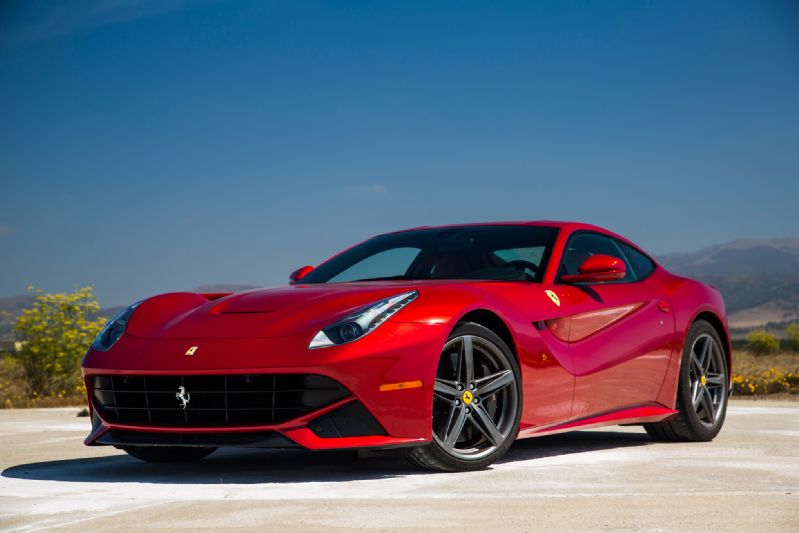
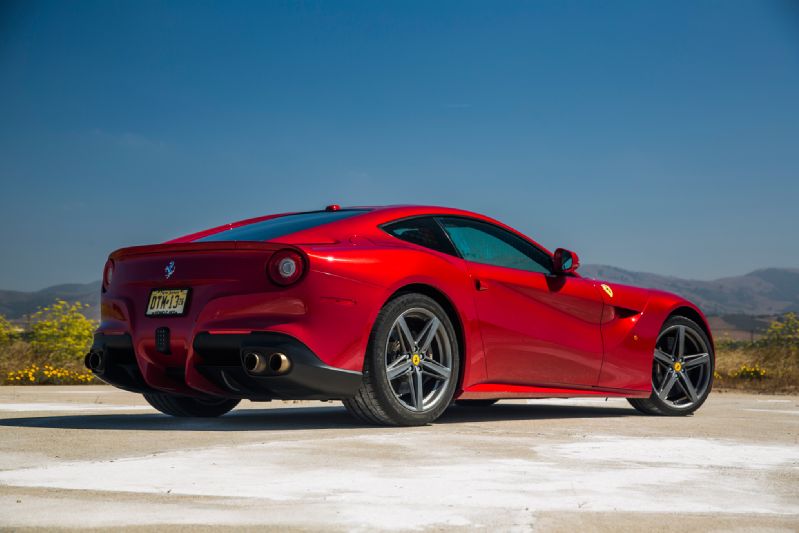
It's not easy being the new kid, especially at the high-performance prep school. With a few notable exceptions, Ferrari doesn't really make bad cars. Many are among the best performers of their generation, and here comes the 2014 F12 Berlinetta, ready to pick up that torch from the Enzo with claims it'll be even quicker than the iconic, all-out supercar that once held several records in our testing books. The new kid thinks he's tough. It will come as no surprise to the auto-literate that the F12 is a very quick car. Let's get right down to it: The Ferrari F12 hits 60 mph from a standstill in 3.6 seconds and runs the quarter mile in 11.3 seconds at a screaming 131.7 mph. It stops from 60 mph in just 106 feet and pulls an estimated 0.99 g on the skid pad. In the ranks of supercars, those are pretty good numbers, but they also provoke questions. A 3.6-second 60-mph time isn't all that great for a 731-hp car with 509 lb-ft of torque. There are several other rear-drive sports cars that will do that with significantly less power. Certain Corvettes, Porsches, McLarens, and even the odd Mustang come to mind. The stopping distance also falls into the realm of very good but not great. An 11.3-second quarter-mile run is even a few tenths slow for the power. The odd figure out is the incredibly high quarter-mile trap speed, which I'll get to in a second. There's another important number, and it helps explain the others: 4003. That's how many pounds the F12 weighs, and as we all know, weight is the enemy of performance. The most analogous new car I can think of, both in numbers and driving experience, is the Jaguar F-Type V-8 S. It weighs 3965 pounds, hits 60 mph in 3.9 seconds, runs the quarter mile in 12.1 seconds at 120.2 mph, stops in 106 feet and pulls 1.01 g on the skidpad. Here's the "but:" The F-Type V-8 S makes just 488 hp and 461 lb-ft of torque. What's going on here, then? That smoking quarter-mile trap speed tells the story, and the moral is grip. The F12 doesn't have it. At least, not during a hard launch. Even using launch control (branded Performance Start), the F12 spins its rear tires through second gear and well into third. All the while, the rear end wanders about and requires a number of small corrections to keep it pointed the right way. These aren't cheap tires we're talking about, either. The F12 wears standard Michelin Pilot Super Sports, some of the best street tires you can buy short of barely legal cup tires. The immense power of that 6.3-liter V-12 simply overwhelms them, and there's nothing the computers can do about it. We tried launching without Performance Start to see if that would help, but it just spun the tires more because the computers weren't trying to meter the torque. As it if mattered at that point, the transmission clutches didn't engage as aggressively, either. Nor did getting the tires hot help. The result is that in any kind of drag-racing scenario involving cars nearly as quick, you'll be watching taillights as the F12 fights for bite. Once it digs, though, everything goes plaid. With the rear tires in the game, the F12 accelerates like few other cars, naturally aspirated or otherwise. Only the Lamborghini Aventador and McLaren 12C come to mind. As a result of all the tire spin at launch, the F12 feels as though it's accelerating harder at the quarter-mile mark than it has been at any point since launch. It's an absolutely incredible rush, matched only by the accompanying V-12 howl. As with the launch, though, our tester liked to wiggle just a little when braking hard from that speed, which is equally exciting, if not more so. All this also adds up to a car that isn't quite what Ferrari promised. At launch, Ferrari estimated it would hit 60 mph in 3 seconds flat, making it the quickest Ferrari road car ever, the Enzo included. Our test crew, which does more drag-race launches than just about any other team on the planet, figures the F12 would be good for a quicker sprint to 60 mph and a lower quarter-mile time if it could hook up the tires, but it's got a long way to go to catch the Enzo we tested in 2004. That mighty car hit 60 mph in just 3.4 seconds and ran the quarter-mile in 11 seconds flat at 133.9 mph. That's a lot to make up in drag racing terms. Cornering adhesion is likewise less than we'd hoped for. At 0.99 g estimated, it's less grippy than the Jaguar F-type mentioned earlier, and, again, less grippy than several other top-dollar supercars. It is, at least, grippier than the 10-year-old Enzo. Here again, the F12's immense power simply overwhelms the rear tires, electronic differential and fancy computers be damned. This car needs more tire. |