12:40AM - 01.12.'13
|
News Source: motortrend.com
|
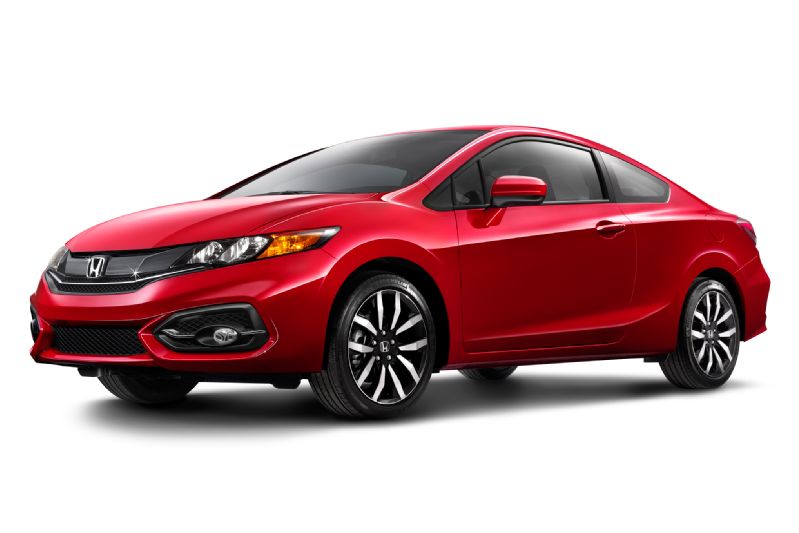
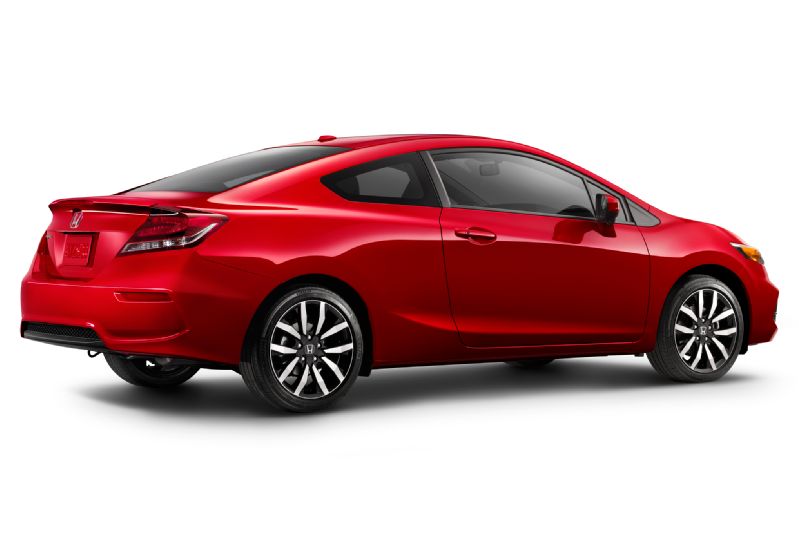
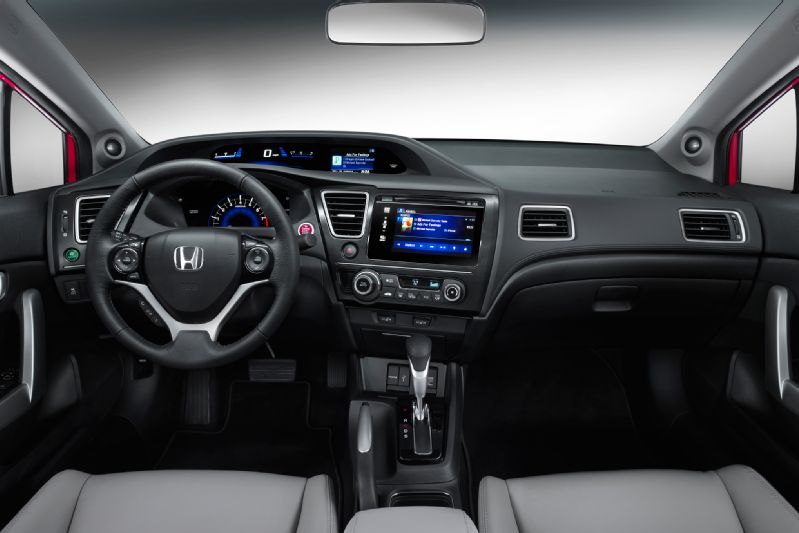
If you've lost track of the ongoing Honda Civic saga, I'll catch you up. The Civic was redesigned for 2012, but received lukewarm reviews. Despite strong sales, Honda decided an emergency refresh was in order, and it was out for the 2013 model year, but the sedan received most of the updates while the coupe soldiered on relatively the same. Now, for 2014, the coupe received the big update as well, and the sedan picked up a few more improvements still. Got it? Good. Let's start with the improvements both cars received. The two biggest changes you're likely to notice will be the new continuously variable transmission and the all-new infotainment system. The CVT replaces the ancient and out-classed five-speed automatic and does so in fine form. It's related but not identical to the new CVT in the larger Accord, but behaves the same way. It's one of the best CVTs on the market in my estimation, behaving somewhat similarly to a standard automatic transmission in simulating shifts rather than jumping to one RPM point and sitting there. Its greatest advantage, bar none, is that it's much, much smoother than the old five-speed. All of the jerkiness of the old gearbox at throttle tip-in and during shifts is gone. Driven back-to-back against a 2013 model, the whole powertrain feels smoother and more refined. More good news: Honda estimates city fuel economy for the sedan will improve by two mpg to 30, which will help push combined fuel economy to 33 mpg from 32. Highway fuel economy holds at 39 MPG. If you want more, the Civic HF is likewise improved, picking up two mpg city, one highway and two combined for a total of 31 city, 42 highway and 35 combined. Numbers for the coupe haven't been announced yet, but they'll likely be the same. If the CVT has a drawback, it makes the Civic feel slightly slower off the line. The aggressive first gear in the old five-speed meant you got pushed back in the seat a little when starting from a stop with moderate throttle. The CVT eliminates that surge, which while smoother, feels as though the car isn't pulling as hard from a stop. We'll have to wait until we can test the car to see if there's any actual difference in acceleration, but I doubt it. Beyond that feeling at launch, the new Civics feel no faster or slower than last year's. Unless, of course, you drop it into Sport. That's right. The automatic Civic finally has a Sport mode and even paddle shifters. As you'd expect, Sport makes the throttle calibration more aggressive and keeps the revs higher. The result is a car that feels a bit more peppy and responsive. It frankly makes the standard Drive mode feel a little lethargic by comparison. In Drive, the emphasis is clearly on comfort and relaxation. The paddle shifters, should you choose to use them, will treat the CVT like a seven-speed gearbox and it shifts between those faux gears pretty quickly. Testing, as I said, will have to wait for another day, but we can make an educated guess here. The 2014 Civic matches its new CVT to the same engine, but sports a new exhaust system that adds three horsepower and one pound-foot of torque. As such, we can confidently guess that the zero-to-60 mph time won't deviate much from the 9.1 seconds we recorded for a 2013 model. A roughly 17-second quarter-mile is likely as well, as is the 119-foot stopping distance we recorded last time. The only performance metric that could change would be the cornering grip, and that would be limited to the coupe. It gets new dampers, slightly stiffer springs and a stiffer rear anti-roll bar, along with new 16-inch wheels and tires. Altogether, they may help lift the coupe's skid pad and figure eight numbers slightly from the 0.81 average g and the 28.5-second lap at 0.58 average g we recorded on that 2013 sedan. On our admittedly short test drive, the new coupe's handling didn't seem drastically different than the sedan's, with perhaps a bit better roll control when cornering and a slightly stiffer ride. Both cars still feel pretty light and handle reasonably well for the class. The steering continues to feel light and artificial, with no feedback from the road. Matches the relaxed powertrain. |